Moving Gas Cylinders Safely: The Risks and the US Rules
Changing a gas cylinder is one of the most routine jobs in a welding shop, and one of the easiest to get wrong. Here's what can go wrong when cylinders are moved and lifted by hand, and what US workplace rules and guidance say about it.
What can go wrong
Back and shoulder injuries
Hugging a cylinder and heaving it onto a welder puts the whole load on your back, shoulders and elbows. A large argon or mixed-gas cylinder can weigh around 176 to 220 lb, and it has no handles to grip.
Dropped cylinders and crushed feet
A cylinder that slips while it's being walked, lifted or set down can land on feet or trap hands. It can also knock over people and equipment nearby.
Damaged valves and leaks
OSHA's welding rules warn that rough handling, knocks or falls can damage the cylinder, its valve or its safety devices and cause leakage. A leak from a high-pressure cylinder is a hazard in its own right.
What US rules and guidance say
OSHA, general industry welding (29 CFR 1910.253). Cylinders must not be dropped or struck or allowed to strike each other violently. Valve-protection caps must not be used to lift cylinders. Valves must be closed before cylinders are moved, and unless a cylinder is secured on a special truck, the regulator must be removed and the valve-protection cap put in place first.
OSHA, compressed gases (29 CFR 1910.101). The in-plant handling, storage and use of compressed gas cylinders must follow Compressed Gas Association Pamphlet P-1-1965.
OSHA, construction (29 CFR 1926.350). On construction work, cylinders must be kept secured upright at all times, except briefly while they're actually being hoisted or carried. When hoisted, they must sit on a cradle, slingboard or pallet, never on magnets or choker slings. The rule says cylinders should be moved by tilting and rolling them on their bottom edges, and never dropped or struck.
OSHA and lifting limits. OSHA has no standard that sets a maximum weight a worker may lift or carry. Instead, under the General Duty Clause of the OSH Act, employers must keep workplaces free from recognized serious hazards, and OSHA says that includes ergonomic hazards.
NIOSH lifting guidelines. NIOSH, the federal agency that researches workplace safety, publishes the Revised NIOSH Lifting Equation for two-handed lifting. It starts from 51 lb as the recommended limit for an ideal lift and reduces that figure for distance from the body, lift height, travel, twisting, how often the lift is repeated and how good the grip is. NIOSH says lifts that exceed the recommended limit pose an increased risk of lower back pain for some workers.
A note on approvals. OSHA doesn't approve or certify products, and the NIOSH equation is a way to assess lifting tasks, not a product approval.
A safer routine for every cylinder change
- 1Close the valve, remove the regulator and fit the valve-protection cap before moving the cylinder.
- 2Never lift or move a cylinder by its cap.
- 3Strap the cylinder securely before tilting or moving it.
- 4Don't drop cylinders or let them knock into each other.
- 5Once the cylinder is in place, keep it upright and chained or strapped to the welder's carrier.
- 6Wear safety footwear and gloves.
Where the Cylinder Lifter fits
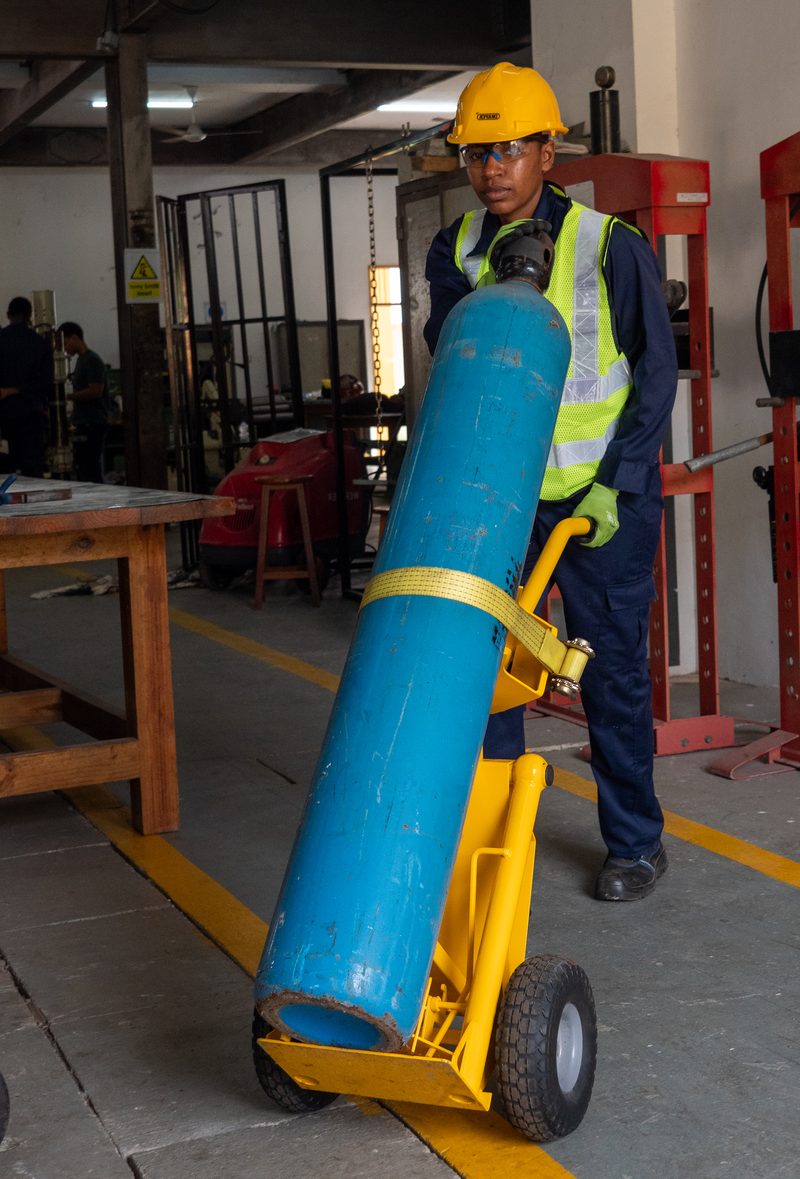
The Cylinder Lifter is a non-powered lifting cart built to take the hand lift out of a cylinder change. A 2" ratchet strap holds the cylinder to the frame, the frame and pivot carry the load so that only about 31 lb reaches the handle, and the cylinder is set onto platforms up to 10" high. It's rated for cylinders up to 220 lb and about 10" in diameter.
This page is a plain-English summary, not legal advice. Check the full OSHA standards that apply to your workplace.
Have a question about the Cylinder Lifter?
Our FAQ covers cylinder sizes, lift height, shipping and returns.